
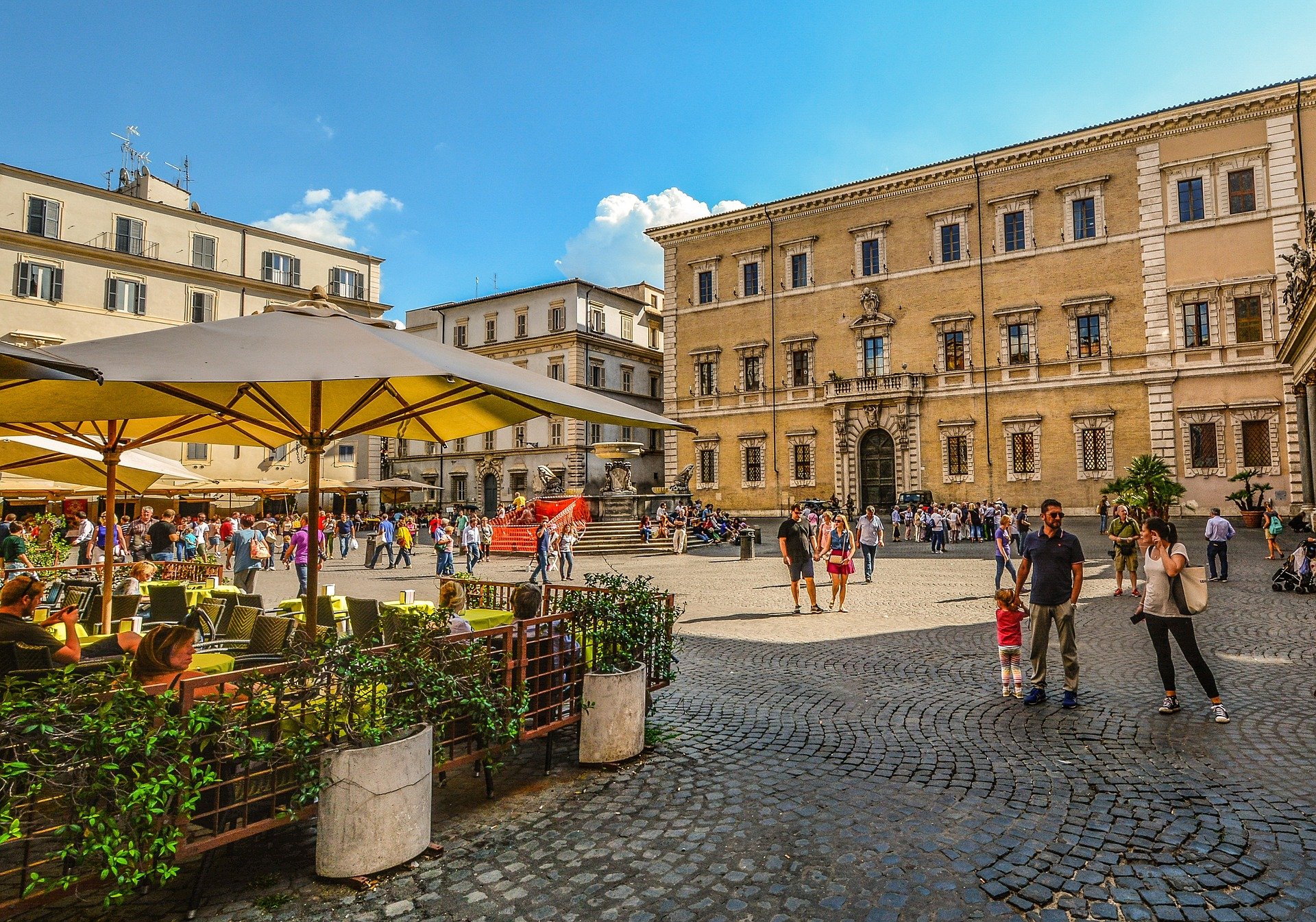
Ask ten travellers about the best time to visit Rome and you will get ten different answers, because they are answering slightly different questions. Someone chasing warm evenings wants July. Someone who hates queues wants February. Someone watching their budget wants the week after the Christmas markets come down. Rome has no single best month — it has a best month for you, and it depends on how you weigh weather, crowds, prices, and what you want to do once you are here.
If you want the short version: April to May and September to October are the sweet spots. The weather is warm without being punishing, the light is beautiful, and the city is busy but still liveable. Everything below explains what you gain and what you give up in every other part of the year.
Spring in Rome (March to May)
Spring is when Rome looks like the version of itself you had in your head. March still carries a chill and a decent chance of rain, with highs around 16°C, but by April the city has turned: wisteria spills over walls in Trastevere and the Villa Borghese gardens fill up with people simply sitting in the sun.
May is arguably the single best month of the year. Highs sit in the mid-twenties, evenings are warm enough to eat outside without a jacket, and the heat has not yet become the thing that organises your day. The trade-off is that everyone else has noticed. Spring is peak season for ticketed sites, and the Colosseum and Vatican Museums run close to capacity from mid-April onwards.
One thing to plan around: Easter. The week around it brings enormous crowds to the Vatican for the papal ceremonies, and hotel rates in the centre rise accordingly. If your trip falls in that window, book everything early.
Summer in Rome (June to August)
Summer in Rome is hot, bright and loud, and it rewards travellers who adapt to it rather than fight it. June is still genuinely pleasant, with long days and highs around 28°C. July and August are a different proposition: temperatures regularly climb past 33°C, the stone of the city holds the heat well into the night, and the middle of the day on an unshaded site like the Roman Forum is hard work.
August has a character all its own. Many Romans leave the city for the holidays, and around Ferragosto on 15 August a noticeable number of family-run restaurants and shops simply close for two or three weeks. The tourist-facing city stays fully open, but neighbourhoods feel emptier and quieter than at any other time of year — which some visitors love.
How to survive a Roman summer: start at 8am and treat 1pm to 4pm as indoor time, in a museum, a church or over a long lunch. Carry a refillable bottle and use the nasoni, the cast-iron street fountains that run cold drinkable water all over the city. Save open-air sites for early morning. Doing the Vatican and the Colosseum on the same day works far better when the timing is planned around the heat, which is one reason a structured full-day Vatican and Colosseum tour makes more sense in July than improvising.
Autumn in Rome (September to October)
For a lot of people who know the city well, autumn is the answer. September still feels like summer without the worst of the heat. October is the real prize: mild days, cool evenings, and a low golden light that makes the travertine glow. The summer crowds have thinned, prices soften from mid-September, and the city goes back to being a working capital rather than a stage set.
Autumn is also when eating in Rome is at its best — artichokes, porcini, new olive oil — and when walking the city for hours is comfortable again. An evening on foot through the piazzas is a genuine pleasure in October in a way it is not in August, which is why a tour of Rome’s squares and fountains lands so well in this season.
The one caveat: rainfall picks up from mid-October, and November is statistically the wettest month of the year. Pack a light rain jacket and plan an indoor option for one afternoon.
Winter in Rome (November to February)
Winter is Rome’s best-kept secret and its biggest trade-off. On the plus side, this is low season in the truest sense: flights and hotels are at their cheapest, restaurants have tables, and you can stand in front of the Trevi Fountain or walk the Forum with room to breathe.
The weather is cooler than people expect but rarely harsh. Daytime highs hover around 12–14°C, snow is very rare, and the main risk is rain rather than cold. Days are short, so an early start matters more than in summer.
December is its own case. The city dresses up, nativity scenes go on display in churches across the centre, and the Christmas season runs through to Epiphany on 6 January. The weeks either side of Christmas are busy and priced accordingly; mid-January to late February is the quietest, cheapest stretch of the year.
Rome month by month at a glance
| Month | Typical high | Crowds | Prices |
|---|---|---|---|
| January | 12°C / 54°F | Very low | € Lowest |
| February | 13°C / 55°F | Very low | € Lowest |
| March | 16°C / 61°F | Moderate | €€ Low |
| April | 19°C / 66°F | High | €€€ High |
| May | 24°C / 75°F | High | €€€ High |
| June | 28°C / 82°F | High | €€€ High |
| July | 31°C / 88°F | Very high | €€ Mid |
| August | 31°C / 88°F | High | €€ Mid |
| September | 27°C / 81°F | High | €€€ High |
| October | 22°C / 72°F | Moderate | €€ Mid |
| November | 16°C / 61°F | Low | € Low |
| December | 12°C / 54°F | Low, spiking at Christmas | € Low, €€€ at Christmas |
Events and holidays worth planning around
- Easter (March or April) — the busiest religious week of the year. Papal ceremonies at the Vatican and the Via Crucis at the Colosseum draw huge numbers; central hotels sell out months ahead.
- Natale di Roma, 21 April — the city’s own birthday, marking its legendary founding in 753 BC. Expect processions in costume, events at the archaeological sites and a genuinely local atmosphere.
- Ferragosto, 15 August — the mid-August public holiday. Many independent businesses close around it; the city is hot and unusually quiet.
- Christmas and Epiphany (December to 6 January) — nativity displays, lights along Via del Corso, and a festive season that runs two weeks longer than most travellers expect.
Best for your budget, the weather, or an empty city
Best value
Mid-January to late February, and the first three weeks of November. Flights and accommodation are at their lowest, and you will not queue for anything.
Best weather
Late April to mid-June, and all of September and October. Warm, dry, long evenings, and comfortable walking conditions.
Fewest tourists
February, closely followed by early December and mid-November. August is a strange middle case: fewer Romans, but no shortage of visitors at the major sites.
One practical warning about high season
Whatever month you choose, the constraint is the same: timed-entry tickets for the Colosseum and the Vatican Museums sell out. From April to October they can be gone weeks in advance. Travellers who wait until they land routinely find the only remaining option is a late-afternoon slot on their last day.
This is the single strongest argument for booking a private guided visit early. A private tour of Rome comes with the entrance tickets and skip-the-line access already secured, so the date and time you want are locked in. Kai Travel runs private tours only — no shared groups — with a fixed guide fee and entrance tickets charged per traveller, so a small family or a group of friends sees the cost per person fall rather than rise.
If you already know roughly when you are coming and want help matching the season to the right itinerary, get in touch and we will put something together around your dates.
Frequently asked questions
What is the least crowded month in Rome?
February. Christmas and New Year are over, Easter is still some way off, and the major sites are as quiet as they ever get. Expect cool weather and a reasonable chance of rain, but also short queues.
When is the cheapest time to visit Rome?
Mid-January through February is the cheapest overall, with early to mid-November a close second. Flights, hotels and short-term rentals all drop outside the Christmas fortnight. Avoid the days immediately around Christmas, New Year and Easter, which price like peak summer.
Is Rome too hot in July and August?
It is hot — regularly above 33°C — but it is manageable if you plan around it. Start early, spend the early afternoon indoors, drink constantly from the street fountains, and save open sites like the Forum for the first hours of the day. Plenty of people have a wonderful time in Rome in August; almost none of them try to walk the Forum at 2pm.
Is Rome worth visiting in winter?
Very much so. Winter gives you the city without the queues and at the lowest prices of the year. You trade long warm evenings for short cool days, and you should pack for rain — but standing in an almost-empty Pantheon in January is an experience the summer simply cannot offer.


