
Some of Rome’s most unforgettable moments don’t happen inside a museum – they happen in the street. A coin tossed into the Trevi Fountain at dusk, an espresso in the shadow of the Pantheon, the sudden hush of Piazza Navona at first light. This Rome walking tour links the city’s four most beautiful piazzas and monuments into one easy, mostly flat route through the historic centre. Below you’ll find the ideal order to walk it, what to see at each stop, how long it takes, and a few insider tips to help you skip the crowds.
Why explore Rome’s historic centre on foot
Rome’s centro storico is compact, pedestrian-friendly and almost entirely closed to traffic, which makes walking by far the best way to see it. The distance between the Spanish Steps, the Trevi Fountain, the Pantheon and Piazza Navona is under two kilometres in total – a stroll of about 25 minutes if you walked it without stopping. In practice you’ll want two to three hours to enjoy it properly, longer if you stop for lunch or gelato along the way.
Unlike the Colosseum or the Vatican, none of these landmarks require a ticket, which is part of their charm: you simply arrive, look up and take it in. That freedom is also the catch. Without context, it’s easy to snap a photo and move on, missing the stories that make each square come alive. A knowledgeable local guide turns a pleasant walk into the highlight of your trip – more on that below.
The perfect walking route: Spanish Steps to Piazza Navona
The route below flows naturally downhill and westward, so you finish near great restaurants and wine bars for the evening. Start in the late afternoon and you’ll catch the golden light that makes Rome’s travertine glow.
1. Piazza di Spagna and the Spanish Steps
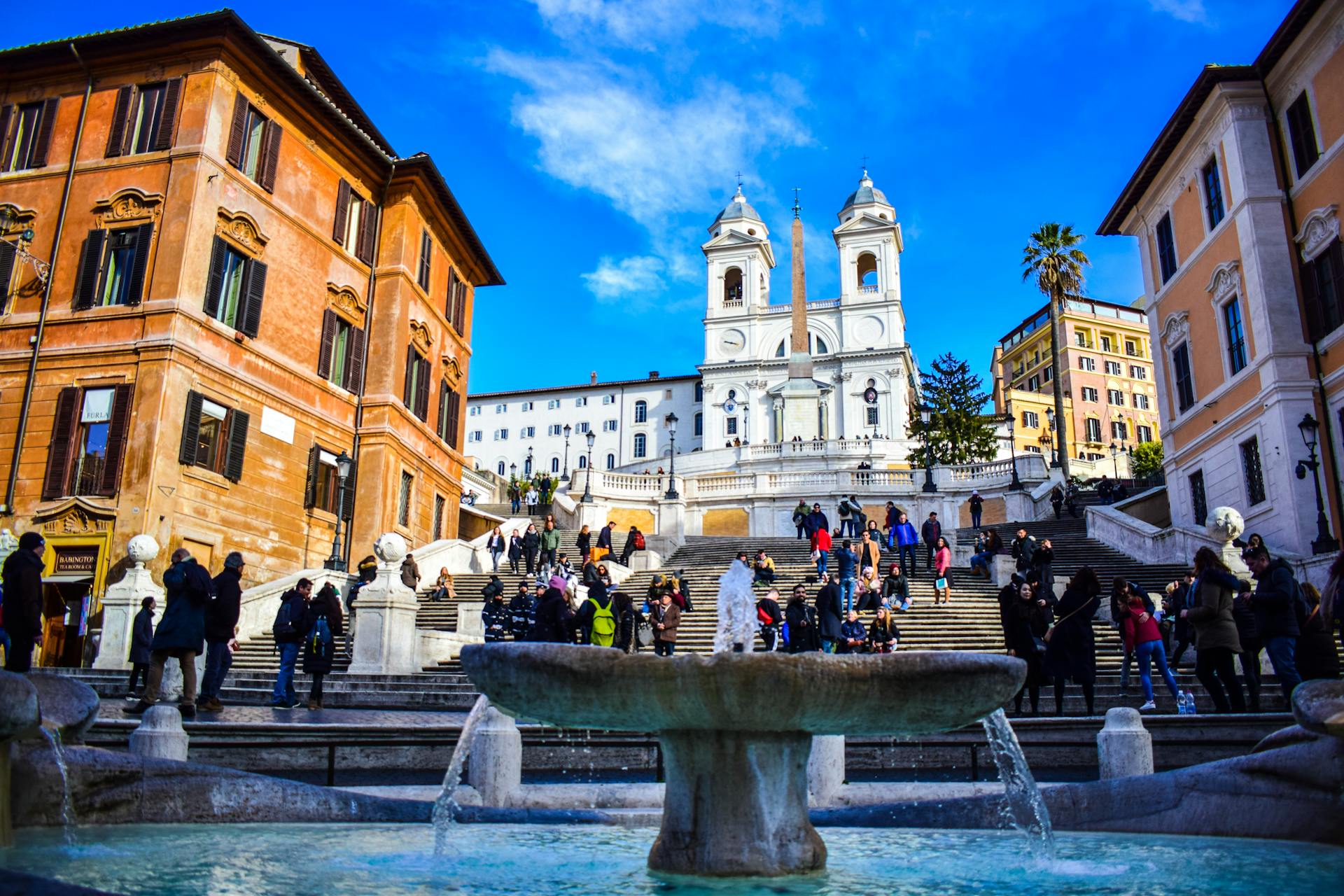
Begin at the Spanish Steps (Scalinata di Trinità dei Monti), the grand 18th-century staircase that sweeps up from Piazza di Spagna to the twin-towered church above. At the foot of the steps sits Bernini’s playful Barcaccia fountain, shaped like a half-sunken boat. This is Rome’s fashion district, so it’s also the perfect spot to window-shop along Via dei Condotti. Remember: sitting on the steps is now prohibited and fined, so admire them standing.
2. The Trevi Fountain
A five-minute walk south brings you to the show-stopper: the Trevi Fountain. Nicolas Salvi’s baroque masterpiece is a wall of gods, tritons and sea-horses fed by an ancient Roman aqueduct, the Acqua Vergine. Tradition says a coin thrown over your left shoulder with your right hand guarantees your return to Rome. Come very early (before 9am) or after dark to see it without the daytime crush – and to get that dream photo.
3. The Pantheon
Continue west to the Pantheon, the best-preserved monument of ancient Rome and, for many visitors, the single most breathtaking building in the city. Built by the emperor Hadrian around 126 AD, its vast unreinforced concrete dome – still the largest in the world of its kind – is pierced by a nine-metre oculus open to the sky. Step inside and watch the shaft of sunlight travel across the marble as the earth turns. The tombs of the artist Raphael and two Italian kings rest within.
4. Piazza Navona
End your walk in Piazza Navona, Rome’s most theatrical square, laid out over the ruins of a Roman stadium. Its centrepiece is Bernini’s Fountain of the Four Rivers, an extravagant sculpture representing the Nile, Ganges, Danube and Río de la Plata. Ringed by cafes, street artists and the baroque facade of Sant’Agnese in Agone, it’s the ideal place to sit with an aperitivo and watch Rome go by.
Hidden stops to add along the way
Part of the joy of walking Rome is what you stumble upon between the big sights. A few short detours reward the curious:
- Sant’Ignazio di Loyola – a few steps from the Pantheon, this church hides a jaw-dropping painted ceiling that creates the illusion of a dome that isn’t really there. Stand on the marble disc in the nave for the full trompe-l’oeil effect.
- Piazza della Rotonda – the square in front of the Pantheon, framed by an Egyptian obelisk and lined with cafes where you can rest with the monument in full view.
- Via dei Coronari – a picture-perfect lane of antique shops and ivy-draped facades connecting the Pantheon area to Piazza Navona, wonderfully quiet in the early morning.
- Gelato and coffee – the historic centre is home to some of Rome’s most famous gelaterie and coffee bars. Ask a local guide where they actually go – the best ones are rarely the busiest.
These small discoveries are exactly where a private walking tour shines: your guide knows which door to open, which corner to turn, and which story turns an ordinary street into a memory.
Practical tips for your Rome walking tour
- Wear comfortable shoes. Rome’s streets are paved with sampietrini, the uneven basalt cobblestones that look wonderful and punish flimsy sandals.
- Carry a refillable bottle. The city’s nasoni drinking fountains pour cold, clean water for free – a lifesaver in summer.
- Go early or late. The centre is busiest from late morning to mid-afternoon. Dawn and the hours after sunset are magical and far quieter.
- Mind your belongings. Crowded squares attract pickpockets; keep bags zipped and in front of you.
- Dress respectfully for churches. Shoulders and knees should be covered to enter the Pantheon and other places of worship.
See it your way with a private guide
Walking this route on your own is lovely. Walking it with a passionate local storyteller is unforgettable. On a private Rome squares and fountains tour with Kai Travel, your guide weaves together two thousand years of history, art and gossip – the papal feuds behind Bernini’s fountains, the ancient aqueducts still feeding the Trevi, the legends hidden in plain sight. Because the tour is private, it moves at your pace: linger where you’re curious, skip what you’re not, and pause for a coffee whenever you like.
Short on time or travelling with family? A golf-cart tour of Rome’s centre covers the same landmarks with far less walking, while our full range of private Rome tours lets you combine the piazzas with the Colosseum, the Vatican or a hidden-Rome itinerary. Every Kai Travel guide is licensed, local and genuinely in love with the city – and it shows.
Frequently asked questions
How long does this Rome walking tour take?
Allow two to three hours at a relaxed pace, including photo stops. The walking distance is under two kilometres, so it suits most fitness levels. With a private guide, tours typically run three hours and can be tailored shorter or longer.
Do I need tickets for the Trevi Fountain, Pantheon or Piazza Navona?
The Trevi Fountain, the Spanish Steps and Piazza Navona are free public spaces. The Pantheon now charges a small entrance fee for general admission; a licensed guide can arrange skip-the-line entry so you don’t queue.
What is the best time of day to walk the historic centre?
Early morning and evening are best: softer light, cooler temperatures and far fewer crowds at the Trevi Fountain in particular. Golden hour before sunset is ideal for photography.
Is the route suitable for children and older travellers?
Yes. It’s flat, short and endlessly interesting for all ages. If walking is a concern, ask us about a private golf-cart option that covers the same sights comfortably.
Ready to discover the beating heart of Rome? Contact Kai Travel to build your perfect private walking tour of Rome’s squares, fountains and timeless pi
Address List
- via A. Saracini, 34 - Roma - Italy
- +39.379.21.666.27
- tour@kaitravel.it
- +39.379.21.666.27
Kai Travel
Kai Travel di Denis Pasolini
P.IVA 03636910402 con sede in Via A. Saracini, 34 – 00121 Roma – Italia
Autorizzazione della Provincia di Roma Protocollo n. QA/2024/15015 rilasciato il 27 Febbraio 2024
Licenza Tour Operator n° 33244


